Accessories · New Product
How to Sharpen Flexible Knives Without Blade Deflection—and Finally Get the Edge They Deserve
Fillet knives, boning knives, and long slicing blades have always been the exception to the precision sharpening rule. The new Blade Stabilizer changes that entirely.
Flexible blades are the sharpening problem nobody talks about enough. Clamp a fillet knife in a precision vise, apply the lateral pressure of a sharpening stone, and the blade does exactly what it was designed to do—flex. That flex changes the effective angle at the apex with every stroke, producing an inconsistent bevel that can't be reliably reproduced. The result is an edge that never quite matches what the same sharpener delivers on a rigid blade. The new Wicked Edge Blade Stabilizer—Standard Vise is purpose-built to eliminate that problem at the source.
Key Takeaways
- → Flexible blades deflect under stone pressure, changing the effective sharpening angle mid-stroke and producing uneven bevels. The Blade Stabilizer eliminates this by adding a second clamping point.
- → The adapter plate mounts between the sharpener base and a sliding auxiliary vise, forming a rail that positions the secondary clamp anywhere along the blade's length.
- → Position the primary vise so the belly of the blade starts just above the rear jaw, then slide the auxiliary vise toward the spine behind that point and lock it down.
- → The stabilizer does not alter your sharpening angle, rod alignment, or clamping height—it only prevents lateral deflection.
- → Fillet knives, boning knives, long carving and slicing blades, and flexible sushi knives all benefit immediately and substantially.
- → One thumbscrew locks the auxiliary vise position on the rail—setup adds under a minute to the normal clamping routine.
The Problem With Sharpening Flexible Blades
Precision sharpening systems work by holding a blade at an exact, repeatable angle while a guided stone removes steel uniformly from both sides. The math is simple: consistent angle plus consistent strokes equals consistent bevel. That equation holds perfectly for rigid blades.
Flexible blades introduce a variable the equation wasn't designed for. The very properties that make a fillet knife exceptional at its job—thin stock, high grind, minimal spine thickness—also make it susceptible to lateral deflection under sharpening pressure. As the stone travels the length of the blade, the apex moves. Not much. But enough. Enough to widen the bevel on one pass, shallow it on the next, and produce an edge that looks acceptable under casual inspection but doesn't hold up the way a properly sharpened blade should.
Experienced sharpeners know the workaround: use extremely light pressure, reduce strokes, work slowly, and accept that flexible blades will always be somewhat less consistent than rigid ones. It's a reasonable adaptation—but it's also a limitation that a purpose-built accessory should be able to remove entirely.
How the Blade Stabilizer Works
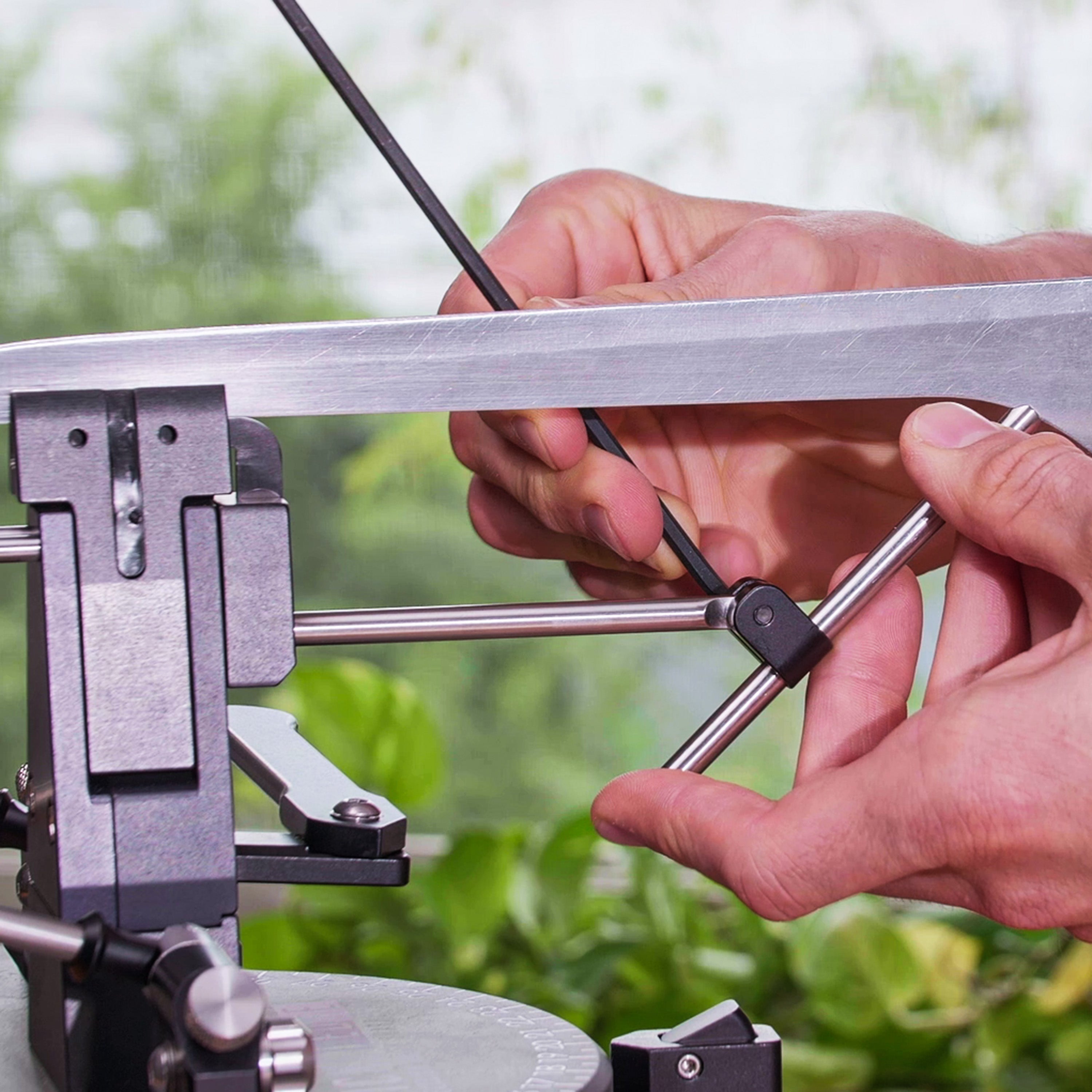
The Blade Stabilizer — Standard Vise consists of two components: an adapter plate and a sliding auxiliary vise. The adapter plate installs between the sharpener base and the primary vise, creating a precision rail that runs parallel to the blade. The auxiliary vise rides that rail and can be positioned anywhere along its length, then locked in place with a single thumbscrew.
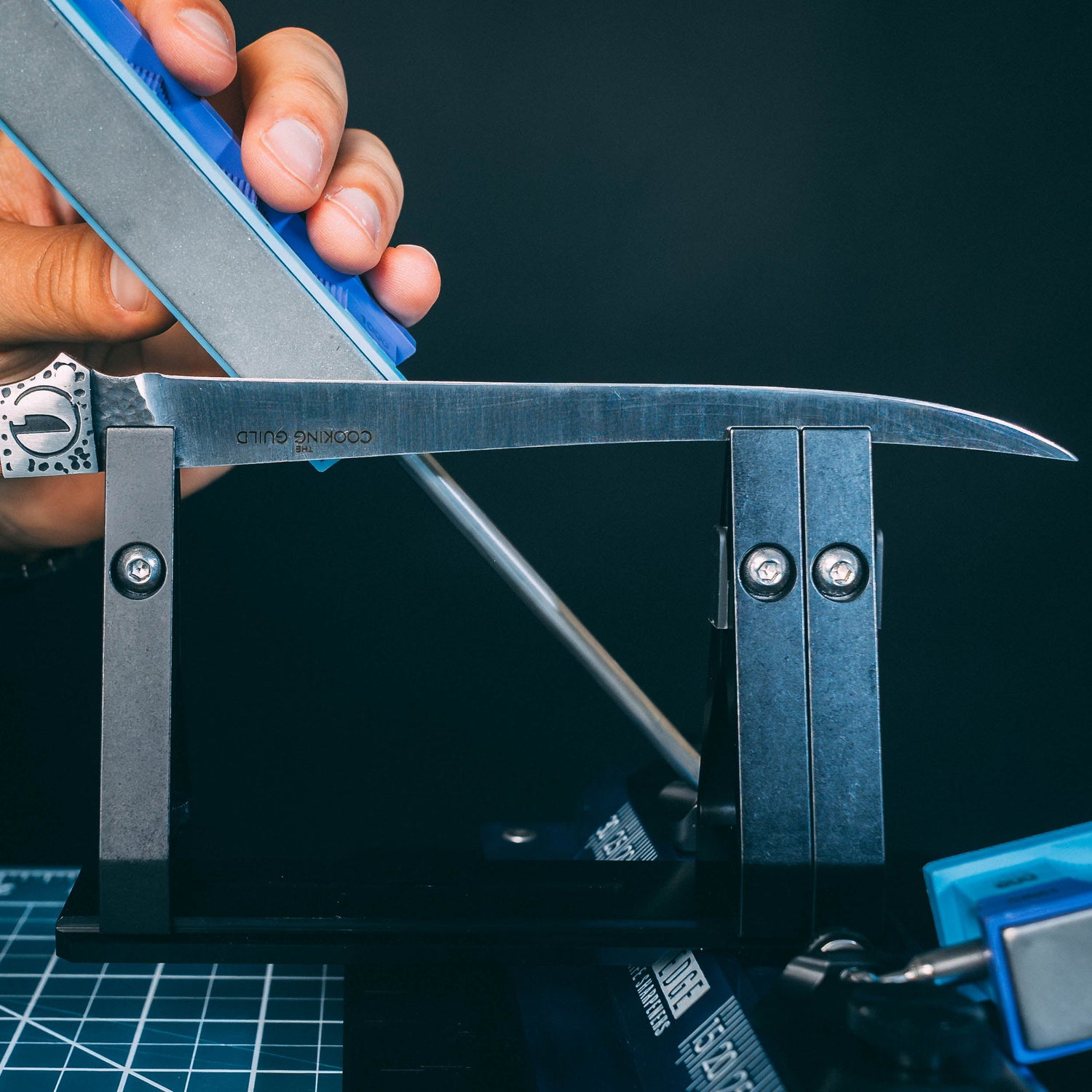
With both vises engaged, the blade is clamped at two independent contact points. It cannot deflect laterally because there is nowhere for it to go. The stones travel the same path they always have, the angle holds exactly as set, and the bevel that results is consistent from heel to tip—the same result you'd expect from sharpening any rigid blade.
The design intentionally keeps the geometry unchanged. The adapter plate does not alter clamping height, and the auxiliary vise contacts the spine without affecting the blade's relationship to the sharpening rods. Your angle settings remain exactly as dialed. The only thing that changes is the blade's freedom to move—which is eliminated.
Setting Up the Blade Stabilizer
Step-by-Step Configuration
Mount the adapter plate. Install the adapter plate between your sharpener base and the primary vise. It seats in the same position as your standard base—no tools required beyond what your sharpener already uses for vise adjustments.
Clamp the blade in the primary vise. Secure your flexible knife exactly as you normally would. Position the blade so the start of the curve—the belly—sits just above the rear jaw of the main vise. This is the critical reference point for auxiliary vise placement.
Loosen the auxiliary vise thumbscrew. With the thumbscrew loose, the auxiliary vise slides freely along the rail. It will not fall—it stays on the rail until deliberately removed.
Slide the auxiliary vise into position. Move it toward the rear of the blade—past the belly, further along the spine toward the tip or wherever the blade shows the most flex. Make clean contact with the spine.
Tighten the thumbscrew. Snug the vise against the spine with consistent, light pressure—enough to eliminate play without deforming thin stock. Tighten the thumbscrew to lock the auxiliary vise position on the rail.
Verify and sharpen. With both vises secured, apply light hand pressure to the blade. It should feel completely rigid. Proceed with your normal sharpening routine at your established angle settings.
Which Knives Benefit Most
Any blade with perceptible flex under sharpening pressure will produce better results with the stabilizer in place. The improvement is most dramatic on dedicated fillet knives—both short flexible models and long freshwater blades—where the combination of thin stock and extended length creates the most deflection. Boning knives with flexible profiles, long carving and slicing knives, and thin sushi blades all fall into the same category.
Rigid blades—thick camping knives, stout German-style chef's knives, most fixed-blade hunting knives—don't require stabilization and will perform identically with or without the accessory installed. The adapter doesn't interfere with sharpening them, so there's no need to remove it between sessions if you're working through a mixed set of knives.
The Blade Stabilizer — Standard Vise is compatible with all Wicked Edge sharpeners running a Standard Vise, including the WE40 Carbon, GO-WE60, WE100, and WE120. It is not compatible with CamLock or DualCam Vise machines—those systems have a dedicated Blade Stabilizer designed for their snap-in mounting interface.
Blade Stabilizer FAQ
Why is it hard to sharpen flexible knives?
Flexible blades deflect under the lateral pressure of a sharpening stone. That deflection changes the effective angle at the apex, producing an inconsistent bevel that cannot be reliably reproduced stroke after stroke. The result is a ragged edge that never quite performs the way a properly sharpened rigid blade does—even if the sharpener and technique are identical.
What is the Wicked Edge Blade Stabilizer?
The Blade Stabilizer is a precision accessory for Wicked Edge bench sharpeners. It consists of an adapter plate that mounts between the sharpener base and a secondary vise. The secondary vise slides along the adapter rail to any position, clamping the blade at a second contact point and eliminating flex during sharpening
Which knives benefit most from the Blade Stabilizer?
Any blade with noticeable flex benefits: fillet and boning knives, slicing and carving knives, flexible sushi blades, and long thin chef's knives. Rigid blades like thick camping knives or stiff German chef's knives don't require stabilization, but the accessory doesn't interfere with sharpening them either.
How do I set up the Blade Stabilizer?
Mount the adapter plate between your sharpener base and the primary vise. Clamp your knife in the main vise as usual, positioning the blade so the start of the curve—the belly—sits just above the rear jaw. Then loosen the auxiliary vise thumbscrew, slide it toward the rear of the blade, and tighten it against the spine. Lock the thumbscrew to fix the vise position on the rail. The blade is now clamped at two points and will not deflect during sharpening.
Does the Blade Stabilizer affect my sharpening angle?
No. The adapter plate and auxiliary vise are designed to hold the blade without altering its geometry relative to the sharpening rods. Your angle settings remain exactly as dialed on the main vise. The stabilizer only prevents lateral movement—it has no effect on angle, height, or rod alignment.
Can I use the Blade Stabilizer on knives with a full bolster or finger guard?
Yes. Because the auxiliary vise clamps to the spine rather than the flat of the blade, it works around most bolster configurations. Position the secondary vise behind the bolster—toward the tip or the rear of the blade—wherever it can make clean contact with the spine without interfering with the main vise geometry.
Flexible blades have always represented the edge case that precision sharpening systems handled least well. Not because the systems were poorly designed—but because no single clamping point can simultaneously position a blade for sharpening and prevent it from doing what flexible blades do. Two contact points solve a problem one never could.
The Blade Stabilizer is a focused answer to a specific, persistent problem. If you sharpen fillet knives, boning knives, long slicers, or any blade that flexes under the stone, the results will be immediate and obvious: consistent bevels, repeatable geometry, and edges that perform the way the rest of your collection already does.
If flexible blades have been the exception in your sharpening system, the Blade Stabilizer makes them the rule.
If your Wicked Edge sharpener uses a CamLock or DualCam Vise, there's a purpose-built version for your system: the Blade Stabilizer — CamLock/DualCam. It uses a different mounting approach designed specifically for those vise types.